What Is Credit Repair?
Credit repair is the process of examining your credit reports, challenging inaccurate or improperly reported information, and pursuing the corrections you are entitled to receive.
It is also an exercise of your consumer rights.
Your credit report can influence access to a home, a vehicle, financing and affordable interest rates. When that report contains errors, the consequences can reach directly into your life. Consumers deserve accurate reporting and a meaningful opportunity to challenge mistakes.
An account that does not belong to you. A payment incorrectly reported late. An inaccurate collection balance. A debt improperly duplicated. Information resulting from identity theft. These are concerns that deserve examination and, when warranted, a documented challenge.
Under the Fair Credit Reporting Act (FCRA), you have the right to dispute inaccurate or incomplete information. Credit bureaus and the companies supplying that information have responsibilities to investigate qualifying disputes and correct reporting errors. You can exercise these rights yourself, without hiring a credit repair company.
Effective credit repair connects those rights to action: identify the problem, explain the inaccuracy, provide supporting evidence, request the appropriate correction and follow through on the response.
Accurate, current negative information generally remains reportable. The strength of a dispute comes from the facts, the supporting documentation and the reporting requirements that apply.
At Cross Colors, our commitment is consumer advocacy.
We believe consumers deserve to understand the information being used to judge their financial standing. They deserve clear explanations, accessible tools and the ability to challenge reporting that may be harming them unfairly.
That commitment drives the technology we are building.
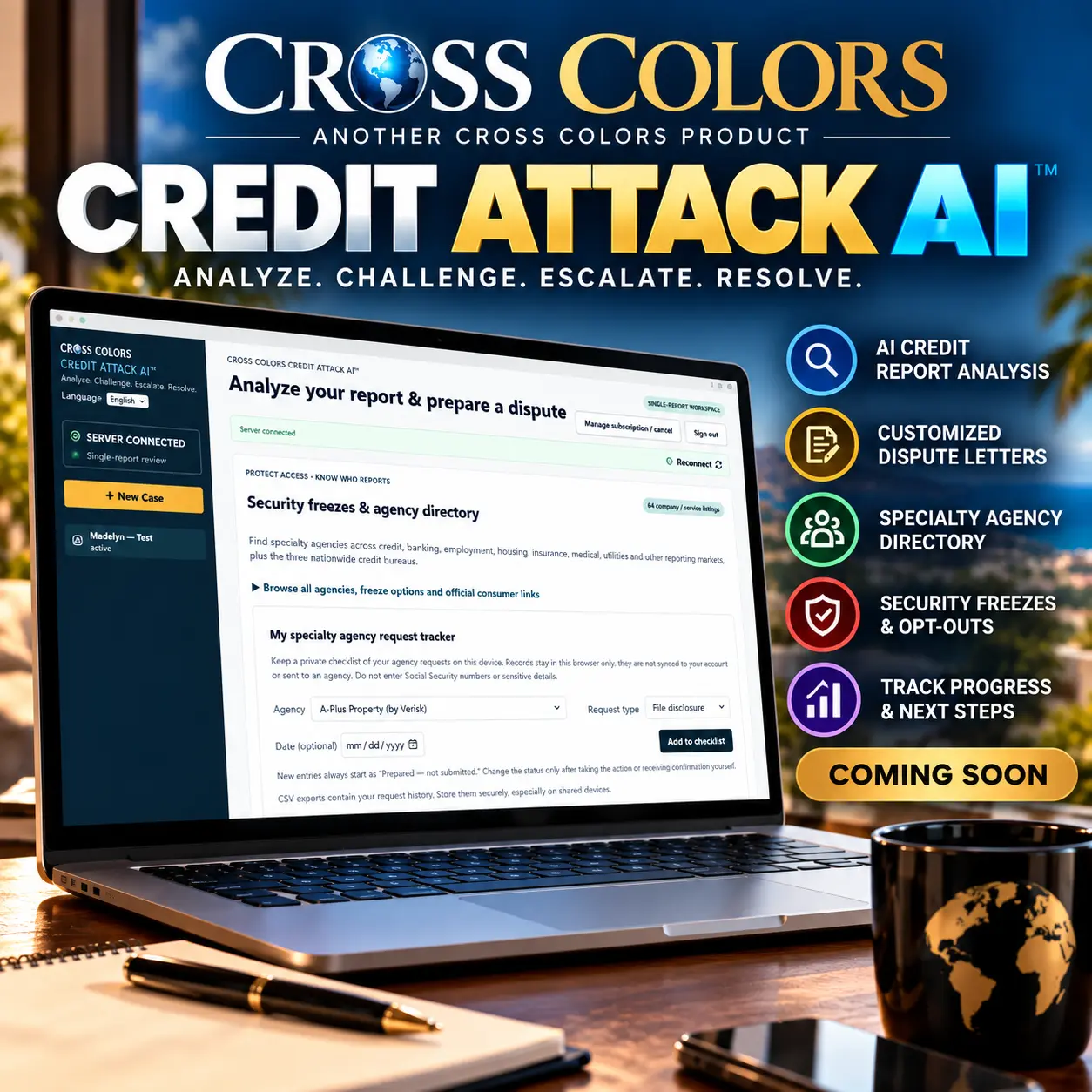
Introducing Cross Colors Credit Attack AI™
Consumer advocacy powered by artificial intelligence.
Cross Colors Credit Attack AI helps consumers move from a confusing credit report to an organized, informed dispute.
Upload your report. The platform helps analyze and organize accounts, collections, inquiries and personal information, bringing potential reporting problems to your attention.
Review the findings, select the items you want to challenge and explain your concerns. The platform then helps prepare personalized dispute letters connected to the information actually appearing in your report and the relief you request.
Our advocacy means helping you understand your rights and put them to work.
The developing Cross Colors Escalation Engine™ extends that vision across the life of a dispute:
Upload → Analyze → Identify → Challenge → Track → Review → Respond → Escalate
It is being designed to help review incoming responses alongside your original report, correspondence and supporting documents, then organize the next appropriate action—from additional evidence and follow-up disputes to preparation for a regulatory complaint when circumstances support it.
Our purpose is to equip consumers to ask informed questions, document their concerns and hold reporting organizations accountable to their responsibilities.
Your credit report. Your rights. Your voice.
CROSS COLORS CREDIT ATTACK AI™
Analyze. Challenge. Escalate. Resolve.
Built to empower consumers. Driven by advocacy.
What we’ve built
“An AI Credit Report Dispute & Resolution Engine”
This is a professional AI-powered credit report analysis, dispute-management, and consumer advocacy application. The platform allows a user to upload one or more credit reports and have advanced AI analyze the reports, identify potentially inaccurate, incomplete, duplicated, obsolete, inconsistent, mixed-file, identity-theft-related, or unverifiable information, determine which organizations are associated with each disputed account, and prepare customized correspondence for the appropriate recipients.
The objective is to have any negative account legitimate or otherwise deleted from your record through a comprehensive and intense dispute based on consumer protection law.
How it works
1. CREDIT REPORT UPLOAD AND AI ANALYSIS
Users upload credit reports in PDF, image, or document format from Equifax, Experian, TransUnion, and other consumer-reporting agencies.
The App extracts and organizes:
Consumer identifying information
Credit bureau name
Creditor or lender name
Account/furnisher name
Account number, with sensitive numbers masked
Account type
Date opened
Account status
Payment history
Current balance
Past-due amount
Credit limit
Date of first delinquency when available
Last reported/updated date
Collection information
Charge-offs
Late payments
Public-record information
Hard inquiries
Addresses
Names and name variations
Employment information
Collection agencies
Original creditors
Remarks and dispute comments
The system then compares information appearing across multiple credit reports and highlights inconsistencies, inaccuracies and errors.
Example:
Experian reports an account balance of $4,800.
Equifax reports the same account at $3,900.
TransUnion lists the account as closed.
The application should flag these differences for review rather than automatically assuming which bureau is wrong.
2. AI DISPUTE DETECTION ENGINE
The system analyzes each negative item you’ve identified and determines the applicable law to have that entry deleted from your report.
Potential issues could include:
Incorrect balances
Incorrect payment history
Incorrect account status
Accounts that do not belong to the consumer
Mixed credit files
Duplicate accounts
Incorrect dates
Potentially obsolete reporting
Re-aged accounts
Incorrect personal information
Unauthorized inquiries
Identity-theft indicators
Incorrect collection information
Incorrect original creditor information
Conflicting information between bureaus
Accounts reported as open when closed
Paid accounts still showing incorrect balances
Possible failure to update information after a dispute
Information that may require verification or documentation
For every flagged issue, it displays:
Problem Detected
Explain exactly what appears questionable.
Evidence
Show the information from the uploaded report that caused the item to be flagged.
Potential Dispute Basis
Explain the possible basis for challenging the information without representing that deletion is guaranteed.
Recipient to be addressed
Identify the organization or organizations that should receive correspondence.
Action you seek
The application does not make recommendations. It supplies a course of options actions appropriate to the dispute, verification request, identity-theft procedure, documentation request, or follow-up.
3. AGENCY AND AFFILIATE IDENTIFICATION
The application identifies the organizations connected with a disputed item.
This may include:
Equifax
Experian
TransUnion
Original creditors
Banks
Credit-card issuers
Auto lenders
Mortgage companies
Student-loan servicers
Debt buyers
Collection agencies
Data furnishers
Specialty consumer-reporting agencies
Tenant-screening agencies
Employment-screening agencies
Check/banking reporting agencies
Relevant affiliate or subsidiary organizations
The application maintains an updatable Agency Directory containing the organization's official name, type, current dispute/contact information, website, mailing address, and the relationship between that organization and the disputed account.
Never guess an address or affiliate relationship. Information that cannot be reliably established should be marked Needs Verification.
4. AI LETTER GENERATOR
The system generates individualized letters for each dispute instead of producing generic mass-dispute templates.
The app uses the facts contained in the uploaded credit report and information supplied by the consumer.
Generated Letters may include:
Credit bureau dispute letters
Direct furnisher disputes
Collection-account disputes
Requests for investigation
Requests for supporting documentation
Identity-theft-related correspondence
Mixed-file dispute letters
Personal-information correction requests
Follow-up letters
Responses to investigation results
Requests concerning reinsertion of previously removed information
Escalation correspondence when appropriate
Each letter clearly identifies the account, describes the specific disputed information, explains the factual basis of the dispute, states the correction or investigation being demanded and avoids making factual or legal claims that cannot be supported.
The user is able to review and edit every letter before downloading or sending it.
5. DISPUTE WORKFLOW
Each dispute has its own case file containing:
Original credit-report information
AI analysis
Dispute reason
Recipient
Generated letters
Supporting documents
Date sent
Tracking information
Response deadline
Agency response
Updated credit report
Follow-up recommendations
Final result
6. RESPONSE ANALYSIS
Users are able to upload letters and investigation results received from bureaus, creditors, collection agencies, and other organizations.
The App compares the responses with:
The original dispute
Original credit report
Evidence submitted
Previous correspondence
Updated credit-report information
The App explains what changed, what remained unchanged, what the organization stated, and next steps.
The system should never fabricate a dispute reason merely to obtain deletion.
7. CONSUMER LAW KNOWLEDGE ENGINE
The App is an updatable knowledge system covering applicable consumer credit-reporting and debt-collection requirements, including the Fair Credit Reporting Act, Fair Debt Collection Practices Act where applicable, identity-theft procedures, CFPB guidance, FTC information, and applicable state or territorial consumer protections.
The App distinguishes between:
Legal requirement
Possible dispute argument
Consumer allegation
AI-detected inconsistency
Confirmed documentation
8. AI CREDIT REPORT ASSISTANT
The App includes a conversational assistant where users can ask questions such as:
“Why is this account being flagged?”
“What's different between my three reports?”
“Who is furnishing this account?”
“Which organization should receive my dispute?”
“Why did the bureau reject my dispute?”
“What documents should I attach?”
“Create a letter based on this error.”
The assistant should answer using the user's uploaded documents and the application's verified regulatory knowledge base.
9. DOCUMENT PACKAGE GENERATOR
After the consumer approves a dispute, the App creates a professional dispute package containing:
Cover letter
Dispute letter
Account summary
Relevant report excerpts
Supporting evidence checklist
Attachment list
Recipient information
Mailing instructions
Allow export to PDF and DOCX.
10. PRIVACY AND SECURITY
Credit reports contain extremely sensitive personal and financial information. The App uses strong security controls, encryption, secure authentication, role-based access, protected document storage, automatic masking of Social Security numbers and account numbers, audit logs, secure deletion controls, and explicit user authorization before documents are transmitted externally.
11. IMPORTANT PRODUCT PRINCIPLE
The application is designed as an AI Credit Report Analysis, Dispute and Resolution System, It is not a system promising to “erase bad credit.”
The central workflow is as follows:
Upload → Analyze → Compare → Identify → Verify → Build Dispute → Review → Send → Track → Analyze Response → Follow Up
The application it designed to help consumers identify and challenge inaccurate, incomplete, obsolete, duplicated, fraudulent, mixed-file, or unverifiable credit-report information while maintaining an evidence trail for every action.
12. USER EXPERIENCE
The interface is simple enough for someone with no knowledge of credit law or credit disputes to use it.
The main dashboard displayed:
Credit Reports
AI Analysis
Potential Errors
Dispute Center
Agency Directory
Letters & Documents
Responses
Case Timeline
Results
13. REGULATORY & ESCALATION ENGINE
The App has a dedicated Regulatory & Escalation Engine built into the application.
The system recognizes that Equifax, Experian, and TransUnion are private consumer reporting agencies and that disputes may involve additional regulatory rights, complaint processes, furnishers, collectors, specialty consumer reporting agencies, and government regulators.
CONSUMER FINANCIAL PROTECTION BUREAU — CFPB
Included in the system is the Consumer Financial Protection Bureau as a major regulatory resource within the application.
Where appropriate, the App recognizes situations in which a consumer may consider escalating an unresolved credit-reporting matter through the CFPB's consumer complaint process.
When escalation appears appropriate the App will display:
CFPB Escalation Available
Then explain:
Why the issue may warrant escalation
What previous disputes have been made
How the company responded
What evidence the consumer possesses
What information should accompany a complaint
The AI should be capable of preparing a CFPB complaint draft based strictly on documented facts.
FEDERAL TRADE COMMISSION — FTC
Include FTC consumer-protection resources within the system.
The App recognizes situations involving potential:
Identity theft
Fraud
Deceptive practices
Consumer reporting concerns
Debt collection concerns
When relevant, the system should direct the consumer toward the appropriate FTC resource and prepare supporting documentation when appropriate.
FAIR CREDIT REPORTING ACT — FCRA
The App understands all the relevant consumer rights and obligations involving:
Accuracy of consumer-report information
Disputes
Reasonable investigations
Correction or deletion of qualifying information
Furnisher responsibilities
Identity theft
Obsolete information
Consumer disclosures
Reinvestigation results
Reinsertion procedures
The system uses the current law and authoritative regulatory guidance rather than relying solely on static letter templates.
The App generates correspondence that cites specific statutory provisions only when the application has determined that the provision is relevant to the facts.
Never insert legal citations simply to make a letter appear more threatening.
ESCALATION LADDER
For every disputed account, create an intelligent escalation workflow.
The system should determine the appropriate path based on the facts rather than automatically sending letters to every organization.
Possible workflow:
Credit Report Issue Detected
↓
Credit Bureau Dispute
Equifax / Experian / TransUnion
↓
Data Furnisher Review
Bank / Lender / Creditor / Servicer / Collector
↓
Specialty Consumer Reporting Agency
When applicable
↓
Response Analysis
AI reviews the investigation results.
↓
Follow-Up Dispute
When supported by new information, documentation, an unresolved discrepancy, or another legitimate basis.
↓
Regulatory Escalation
CFPB / FTC / other appropriate regulator or consumer-protection authority when applicable.
A regulatory escalation — a complaint or referral that may be appropriate after reviewing the circumstances.
The goal is to identify legitimate disputes, direct them to the appropriate organizations, document the consumer's evidence, and intelligently escalate unresolved matters when appropriate.
That makes the CFPB + FTC + FCRA framework part of the actual engine, not just something mentioned in the background.
What is the power of the escalation: CFPB + FTC + FCRA
The power of CFPB + FTC + FCRA is that they should not be treated as three names you simply put into a dispute letter. Together, they can form the logic behind an escalation system.
Think of it this way:
FCRA = the legal rules and consumer rights.
CFPB = a federal complaint and supervisory/enforcement channel.
FTC = another federal enforcement authority, especially relevant to FCRA enforcement, identity theft, fraud, and deceptive practices.
The FTC confirms that the FCRA imposes obligations not only on consumer reporting agencies but also on companies furnishing information to them; the FTC retains FCRA enforcement authority, while significant rulemaking responsibilities were transferred to the CFPB.
Why the escalation engine can be powerful
CrossColorsCreditAttackAi doesn’t simply generate:
“Dear Equifax, please remove this account.”
Instead, the App examines the report and asks: What exactly is wrong? Who supplied the information? What evidence supports the consumer? What legal obligation may apply? What happened in the previous dispute? What is the appropriate next step?
That produces an escalation path such as:
Credit Report → Detect Error → Bureau Dispute → Furnisher Dispute → Analyze Response → Follow-Up → Regulatory Escalation
The CFPB currently advises consumers to dispute credit-report errors with both the reporting company and the company that furnished the information. If an investigation establishes that the furnisher supplied incorrect information, or the information cannot be verified, the furnisher must update or remove it and notify the reporting companies.
That's where this App is much more useful than a template-letter app.
For example, suppose CrossColorsAtaack finds:
TRANSUNION
ABC COLLECTIONS — $4,850
Date of First Delinquency: March 2021
EXPERIAN
ABC COLLECTIONS — $4,850
Date of First Delinquency: September 2022
The system makes no recommendation it gives you options , “Delete this.” Or “Unrecognized Account.”
Then your engine connects the parties:
TransUnion / Experian → ABC Collections → Original Creditor → applicable consumer-reporting law → appropriate escalation channel
It then generates a specific dispute based upon that discrepancy rather than a generic “609 letter.”
Then comes CFPB escalation
This is especially important.
The CFPB says consumers generally must first dispute inaccurate or incomplete information directly with the consumer reporting agency before submitting that type of CFPB complaint. Its current complaint notice also says not to submit while the CRA dispute remains pending, unless more than 45 days have elapsed under the conditions described by CFPB.
So your app could actually enforce the sequence.
ROUND 1 — INITIAL DISPUTE
AI prepares the bureau and appropriate furnisher disputes.
↓
WAITING FOR INVESTIGATION
The app tracks dates, documents, certified-mail information and responses.
↓
RESPONSE RECEIVED
User uploads the response.
↓
AI RESPONSE ANALYSIS
The AI compares the response against the original report, dispute, supporting evidence and applicable requirements.
↓
UNRESOLVED ISSUE
AI determines whether there is a legitimate factual basis for another dispute, additional documentation, or escalation.
↓
CFPB ESCALATION
The system prepares a factual complaint package containing the history, dates, disputed information, previous correspondence, responses and supporting documents.
The CFPB says it forwards complaints to companies for response and that most companies respond within 15 days, although some matters may take longer.
Where the FTC fits
The FTC gives your system another dimension.
For example, when the system detects evidence suggesting identity theft, the workflow shouldn't treat that exactly like an ordinary balance discrepancy. CFPB specifically directs consumers who suspect identity theft to the federal IdentityTheft.gov resource.
So the engine can branch:
Ordinary reporting error → FCRA dispute workflow
versus
Potential identity theft → Identity-theft workflow + FTC resources + FCRA protections
versus
Unresolved reporting problem → appropriate CFPB/regulatory escalation
That's much smarter.
The real advantage: The system remembers the entire case
The system maintains a case history for every disputed item:
Original Report → Problem Detected → Evidence → Bureau → Furnisher → Letter #1 → Date Sent → Response → AI Analysis → Letter #2 → Response → Escalation → Outcome
So when Round 2 occurs, the system isn't starting over.
It knows:
“Experian previously reported X. You disputed X on May 3. Experian responded on May 28. The furnisher reported Y. The new report still shows X. Here are the documents demonstrating the discrepancy.”
That produces a much stronger evidence-driven dispute package than repeatedly sending generic letters.
And the CFPB itself recognizes errors including mixed files, incorrect ownership, incorrect delinquency dates, duplicate debts, incorrect balances and incorrect credit limits—the kinds of discrepancies your AI should be programmed to detect.
That's the power of the escalation engine: not threatening companies with government agencies, but creating a documented, intelligent progression where FCRA provides the legal framework, AI identifies and documents the issue, CFPB provides an escalation/complaint channel when appropriate, and FTC resources/enforcement become relevant to particular FCRA, fraud, identity-theft, or deceptive-practice issues.
Back to Credit Insights